
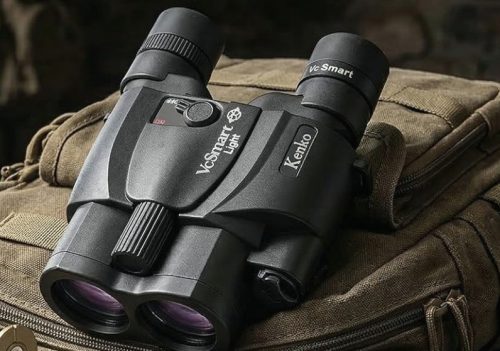
Hand tremors make binocular images appear shaky and difficult to follow, particularly at higher magnifications. The good news is that the best binoculars for shaky hands offer features that help deliver a noticeably steadier view, from image stabilization systems to lightweight designs and ergonomic grips.
This guide explores the best binoculars for shaky hands and the key features that can improve viewing comfort and stability. I’ll cover magnification, image stabilization, weight, ergonomics, optical quality, field of view, eye relief, and focusing performance to help you narrow down the options and enjoy clearer, steadier views for longer.
What to Look for in the Best Binoculars for Shaky Hands
When choosing the best binoculars for shaky hands, look for a pair that features:
1) Nikon STABILIZED 12×25 Binoculars
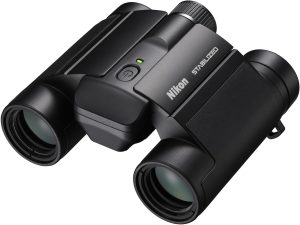
The Nikon STABILIZED 12×25 Binoculars are the best binoculars for shaky hands. They combine high 12x magnification with optical image stabilization in a remarkably compact design.
Their biggest advantage is the stabilization system, which helps reduce the effects of hand movement and keeps distant subjects steadier in the view. This makes the binoculars particularly useful for birdwatching, wildlife observation, sporting events, concerts, and travel.
Furthermore, the 25mm objective lenses keep the body small and portable, while Nikon’s multilayer lens and prism coatings help produce a sharp, high contrast image. At just 13.9 ounces without batteries, the binoculars remain comfortable to carry and hold for extended viewing sessions. The foldable design also makes them easy to pack into a bag when space matters.
In use, the 12x magnification gives users a closer look at distant subjects than typical compact binoculars, although the 4.5-degree field of view is narrower than the 10×25 version. Beyond that, these binoculars use two AA batteries and provide approximately 12 hours of continuous operation, while an automatic shutoff helps conserve power when they remain unused.
Above all, a large central focusing ring makes focusing straightforward, and the adjustable rubber eyecups help users achieve a comfortable viewing position.
Pros
- Effective optical image stabilization
- Compact and lightweight design
- Foldable for easy transportation
- Clear, high-contrast images
- Long 12-hour battery life
- Large, easy-to-use focusing ring
- Adjustable rubber eyecups
Cons
- Narrower field of view than 10×25 models
- Less suitable for low-light viewing
2) SIG SAUER ZULU6 HDX PRO 18x50mm
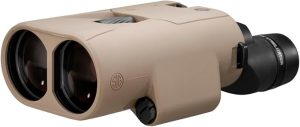
The SIG SAUER ZULU6 HDX PRO 18x50mm FDE Image Stabilized Binoculars combine high magnification with advanced stabilization to deliver a steady, detailed viewing experience.
Their 18x magnification brings distant subjects noticeably closer, while the large 50mm objective lenses gather plenty of light for clearer viewing in changing conditions. Furthermore, the HDX PRO optical system uses redesigned ED glass, prisms, and coatings to improve light transmission, reduce glare, and enhance color accuracy.
These binoculars also feature SIG SAUER’s OmniScan Optical Image Stabilization system, which uses a digital accelerometer to automatically adjust stabilization according to movement and vibration. This makes the 18x magnification much easier to manage by hand, particularly when you need to scan an area or observe a distant subject without immediately reaching for a tripod.
Furthermore, the 3.7-degree field of view, 15.3mm eye relief, and adjustable diopter help create a comfortable viewing experience. The ZULU6 HDX PRO also brings a rugged build and practical features suited to demanding outdoor use.
Pros
- Detailed long-distance viewing
- Strong light-gathering capability
- Excellent clarity, glare control, and color accuracy
- IPX7 waterproof and fogproof construction
- comfortable eye relief
- Tripod compatible for extended stationary observation
Cons
- Premium price
3) Fujinon Techno-Stabi TS-X 14×40 Image Stabilization Binocular
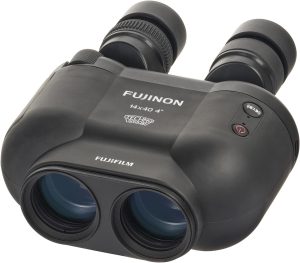
As one of the best binoculars for shaky hands, the TS-X 1440 features an image-stabilizing function, based on Fujifilm’s optical and mechanical design technologies nurtured through its development of interchangeable lenses for digital cameras and broadcast lenses.
The use of a gyro sensor enables accurate detection of even the smallest of vibrations and controls the prism inside the body to achieve the vibration correction angle of ±6°.
With the effective diameter of 40mm for objective lens elements, the TS-X 1440 achieves an advanced level of light-gathering power. Furthermore, the company’s unique EBC Multi-Coating is applied to control flare and ghosting while enhancing light transmittance, perfect for astronomical observation in low-light conditions.
Chromatic aberration is controlled by optimally positioning four objective lens elements in three groups and six ocular lens elements in four groups. This delivers edge-to-edge sharpness.
Beyond that, this binocular is designed with water and fog proof seals for use even in adverse weather conditions. It also features a rubber armored body that allows user to have a firm grip, with or without gloves.
Pros
- Excellent ±6° image stabilization
- Powerful 14x magnification
- Sharp and detailed image
- Fully multicoated optics
- Rugged water-resistant design
- Works with AA and rechargeable NiMH batteries
- Comfortable twist-up eyecups
- Excellent for moving vehicles and boats
Cons
- Relatively heavy at about 1.3 kg
- Expensive compared with conventional binoculars
4) Canon 12×36 Image Stabilization III Binoculars
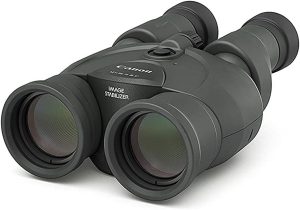
Built with renowned Canon craftsmanship, the 12×36 Image Stabilization III Binoculars are compact, highly portable binoculars that are ideal for birdwatching, hunting, and more.
Their 36mm objective lenses provide a good balance between brightness and portability, while the Porro II prism design and Super Spectra coating help produce sharp, bright, and well-defined images with good color reproduction.
The standout feature remains Canon’s Image Stabilization system, which uses gyro sensors and Vari-Angle Prisms to compensate for hand movement and create a noticeably steadier view. This makes a significant difference at 12x magnification, where even small hand movements can cause distracting image shake.
Furthermore, these binoculars provide 14.5mm of eye relief, making them reasonably comfortable for extended viewing and suitable for users who wear glasses. At 660g without batteries, they remain manageable for handheld use despite their electronic stabilization system.
The Canon 12×36 IS III also offers practical features that make it easy to use in the field. The center focus mechanism provides straightforward focusing, while the ±3 diopter adjustment allows users to fine-tune the view for individual eyesight differences. On top of that, the field of view is wide enough for tracking birds, wildlife, and moving subjects, while the field-flattener elements help maintain sharpness toward the edges of the image.
Pros
- Excellent 12x magnification for distant subjects
- Effective optical image stabilization
- Sharp and bright image quality
- Good edge-to-edge image clarity
- Comfortable 14.5mm eye relief
- Up to 9 hours of IS battery life
- Suitable for birdwatching, wildlife, sports, and travel
Cons
- Relatively bulky compared with conventional binoculars
5) Kenko Image Stabilization Binoculars Vc Smart Cellarto 14×30

The Kenko Vc Smart Cellarto 14×30 are a must-have for everyone who enjoy outdoors. Despite its high 14x magnification, the image stabilization function enables blur-free observation of distant targets.
Its 30mm objective lenses, full multi coating, phase coating, and high reflection coating help deliver bright and high contrast images, while the 3.7° real field of view provides a useful 64.6m viewing width at 1,000m.
Another striking feature is Kenko’s automatic vibration control mode selection, which detects the type of movement and automatically switches to the most suitable stabilization mode. This makes the binoculars particularly useful when following moving subjects, watching concerts or sporting events, and observing distant scenery where hand shake can become more noticeable at 14x magnification.
Furthermore, the 14.5mm eye relief also supports comfortable viewing, while the 3.5m minimum focus distance adds versatility for closer subjects. The Cellarto also emphasizes portability and comfortable handling. Its flat body measures 147 x 51 x 118mm and weighs approximately 462g, making it relatively easy to carry during extended viewing sessions.
A side positioned battery compartment contributes to the ergonomic design, while a simple slide switch makes it easy to activate or deactivate the stabilization system. These binoculars also run on a single AA alkaline battery and provide up to 28 hours of continuous operation, while the removal of the automatic power off feature allows uninterrupted stabilization during long observations.
Pros
- Effective automatic image stabilization
- High 14x magnification
- Compact and lightweight design
- Bright, high contrast images
- Full multi coated optics
- Comfortable 14.5mm eye relief
- Up to 28 hours of battery operation
- Easy to operate slide switch
- Comfortable flat body design
Cons
- Relatively expensive
- Not waterproof
6) Kite Optics APC Stabilized 12×42 Binoculars
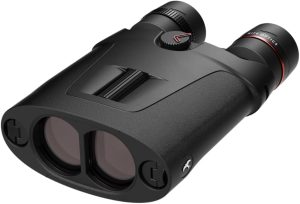
As our final recommendation for the best binoculars for shaky hands, the Kite Optics APC Stabilized 12×42 Binoculars offer exceptional image stability for any environment.
Equipped with a military-grade stabilization system that ensures steady, shake-free viewing even in challenging conditions like strong winds, or while on moving vehicles, boats, or aircraft, you will experience the level of stability trusted by law enforcement and safety operators worldwide.
Beyond that, the high-performance 12x magnification optics lets you enjoy detailed, bright visuals with advanced 42mm roof prism lenses that maintain superior light transmission and clarity. The optical clarity is perfect for capturing intricate details during bird watching, hunting, or observing distant landscapes.
Construction, these binoculars boast a reliable all-weather construction. They are rated IPX 7 for waterproofing and withstand submersion up to 1 meter for 30 minutes. Furthermore, the nitrogen-filled design prevents internal fogging, ensuring clear views in rain, humidity, or sudden temperature changes.
For comfortable extended viewing sessions, the innovative stabilization system reduces hand tremors and suppresses vibrations, allowing for prolonged observation without eye fatigue. These binoculars also feature a generous eye relief for comfortable use with or without eyeglasses.
Pros
- Strong color and contrast
- IPX7 waterproof construction
- Nitrogen-filled for fog resistance
- Up to 120 hours of battery operation
- Automatic sleep function saves power
- Relatively lightweight for stabilized binoculars
Cons
- Narrower field of view
- Higher price than conventional binoculars
Key Factors to Consider when Choosing the Best Binoculars for Shaky Hands
Image Stabilization
Image stabilization should be a top priority when you have difficulty keeping binoculars steady. Stabilized binoculars use optical or electronic systems to counteract hand movement and produce a steadier image. This feature becomes especially valuable at higher magnifications, where even small movements can appear exaggerated.
Magnification
Magnification directly affects how noticeable hand movement becomes. Higher magnification brings distant subjects closer but also makes every small tremor more visible. For shaky hands, moderate magnification such as 7x or 8x often provides a better balance between detail and stability while remaining easier to hold for extended periods.
Weight
Heavy binoculars can quickly cause hand and arm fatigue, which may make shaking more noticeable. Lightweight models place less strain on your hands and allow you to maintain a comfortable grip for longer. However, avoid choosing a model based on weight alone, since extremely lightweight construction may compromise durability or handling.
Ergonomic Design
The best binoculars for shaky hands should have a well-designed body that feels natural and secure in your hands. Look for textured rubber armor, contoured barrels, strategically placed controls, and a comfortable grip that prevents your hands from slipping. An ergonomic design allows you to maintain better control without constantly adjusting your hold.
Optical Quality
Furthermore, clear, bright optics help you see details without forcing your eyes to compensate for a moving image. Look for fully multi-coated lenses, quality glass, good light transmission, and effective glare control. Better optical performance also makes the viewing experience more comfortable, particularly in changing lighting conditions.
Field of View
A wider field of view makes it easier to locate and follow moving subjects. When shaky hands cause the image to move around, a narrow field of view can make your target disappear quickly. Choosing binoculars with a generous field of view gives you more viewing area and makes tracking wildlife, birds, or sporting action easier.
Eye Relief
More importantly, the best binoculars for shaky hands should have adequate eye relief. This will help you maintain a comfortable viewing position without pressing the binoculars tightly against your face whether you wear glasses or not. Look for binoculars with sufficient eye relief and adjustable eyecups so you can maintain a clear view while holding the binoculars in a relaxed position.
Ease of Handling and Focusing
Finally, simple controls can make binoculars much easier to use with shaky hands. Look for a smooth, easy-to-reach focus wheel and controls that you can operate without changing your grip. A model that feels balanced in your hands and allows quick adjustments will help you maintain stability while focusing on your subject.
Next Read:
- 7 Best Binoculars for Alaska Cruise
- 8 Best Monocular for Backpacking
- 7 Best 12×50 Binoculars for Bird Watching
- Best Hiking Poles for Kids
FAQs
- Are image stabilized binoculars good for shaky hands?
Yes. Image stabilized binoculars significantly reduce the effects of hand movement and provide a steadier image. They work particularly well when you use higher magnification or observe distant subjects for extended periods.
- What magnification is best for shaky hands?
7x, 8x, or 10x magnification usually works well for shaky hands because it provides useful detail without making hand movement excessively noticeable. Higher magnification can offer more detail but requires stronger stabilization or additional support.
- Do binoculars with a wider field of view help with shaky hands?
Yes. A wide field of view gives you more viewing area, making it easier to locate and track subjects when the image moves slightly. This can be especially useful for watching birds, wildlife, and sporting events.
Conclusion
The best binoculars for shaky hands should make viewing more stable, comfortable, and effortless. Ultimately, the right pair depends on how and where you plan to use it. If hand tremors significantly affect your viewing experience, image stabilization should receive particular attention. Combine stabilization with a comfortable, well-balanced design, and you will enjoy steadier views of wildlife, landscapes, sports, and other distant subjects.