
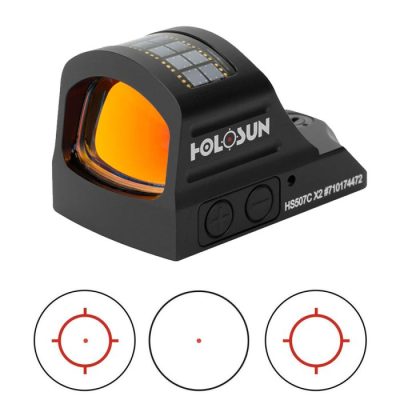
Have you ever felt that your red dot is either overwhelming the target or too hard to see? Reticle size makes a big difference in how quickly you find your aim point, and in this guide, we will show you how to choose the right red dot reticle size.
Irrespective of your use case, choosing the right red dot reticle size is about balancing speed, accuracy, and personal comfort. The best choice will help you acquire the target quickly while still aiming confidently.
Understanding What MOA Means
MOA, or Minute of Angle, is a unit of measurement used to describe the size of a red dot reticle and how much of the target it covers. One MOA equals roughly one inch at 100 yards. This means a 3-MOA dot will cover about three inches of the target at that distance.

As the distance increases, the dot covers more area, and as the distance decreases, it covers less. This means that a smaller MOA dot allows for finer aiming accuracy, while a larger MOA dot is easier to spot and follow quickly.
Common MOA Sizes
Red dot sights are available in several common MOA sizes, each designed to suit different shooting needs:
- Small MOA Dots (1–3 MOA)
Small MOA reticles of 1 MOA to 3 MOA are designed for precision. They cover less of the target, allowing for more accurate shot placement, especially at longer distances. Additionally, these dots are commonly favored by competition shooters and those who prioritize tight groupings over speed. However, they may take slightly longer to acquire, particularly in fast-paced or close-range situations.
- Medium MOA Dots (4–6 MOA)
Medium-sized dots of 4-6 MOA strike a balance between speed and accuracy. They are easy to see without obscuring too much of the target and are a popular choice for all-around use. This MOA range works well for most shooters, especially on pistols, as it supports quick target acquisition while still allowing for controlled, precise shooting at moderate distances.
- Large MOA Dots (6–8 MOA and Larger)
Large MOA dots of 6 MOA and above are built for speed and visibility. Their bold appearance makes them quick to pick up, even in low light or high-stress environments. While they may cover more of the target at distance, they excel in close-range shooting where rapid target acquisition is more important than fine precision.
How to Choose the Right Red Dot Reticle Size: Key Factors to Consider
Here are the most important factors to consider when buying a red dot sight:
Intended Use
The primary purpose of your red dot sight should guide your reticle size choice. Defensive
and close-range shooting generally benefits from larger dots of 4 MOA and above. These reticles are easy to see quickly, even for individuals with aging eyes. On the other hand, competition, hunting, or precision shooting often favors smaller dots of 3 MOA and below for more accurate shot placement.
Typical Shooting Distance
The distance at which you most often shoot plays a major role in reticle size selection. Choose a smaller 3 MOA for long-distance shooting because they cover less of the target, while larger dots above 4 MOA are more effective at short ranges where speed matters more than fine precision.
Speed vs. Precision
Furthermore, your shooting priorities matter. If rapid target acquisition is your main goal, a larger reticle will help you get on target faster. If accuracy and tight groupings are more important, choose a smaller reticle as it allows for finer aiming control.
Eyesight and Visual Comfort
Individual eyesight affects how a dot appears. Shooters with aging eyes or minor vision issues should choose larger dots as they are easier to see. On the other hand, smaller dots can appear faint or harder to track. Comfort and clarity should always be considered.
Brightness Adjustment and Bloom
Brightness settings influence how large the dot appears. A small dot set too bright can bloom and look larger, while an overly bright large dot may obscure the target. Choosing a reticle size that works well across brightness levels improves usability in different lighting conditions.
Firearm Type
Moreover, the type of firearm you are using plays a part in influencing the ideal MOA size. Pistols often benefit from medium to larger dots for faster sight acquisition, while rifles and pistol-caliber carbines typically pair well with smaller dots of 3 MOA and below for better accuracy at distance.
Target Size
The size of your typical targets should be considered. Smaller targets are easier to engage with smaller MOA dots that do not cover the aiming point. However, if you are targeting a larger object and wondering how to choose the right red dot reticle size, you will engage them effectively with larger dots without sacrificing performance.
Shooting Environment
Lighting conditions and background contrast affect dot visibility. In bright outdoor environments or against complex backgrounds, a larger dot will stand out better, whereas controlled indoor or range environments allow effective use of smaller dots.
Experience Level
New shooters often find larger dots easier to acquire and track, helping build confidence and consistency. If you are a more experienced shooter and wondering how to choose the right red dot reticle size for faster target acquisition, improved accuracy, and better shooting performance in any scenario, opt for smaller dots that allow for refined aiming and greater precision.
Personal Preference and Training
Ultimately, comfort and familiarity matter. The best reticle size is one that feels natural during regular practice and matches your training style. Spending time shooting with different MOA sizes is the most reliable way to determine what works best for you.
What About Multi-Reticle System Red Dots?
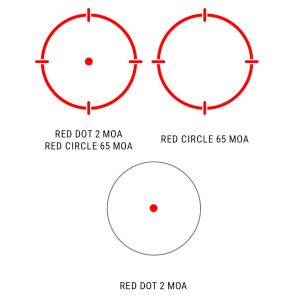
Multi-reticle systems are red dot sights that offer more than one reticle option, typically combining a small dot with a larger circle or additional aiming points. These systems give shooters flexibility to adapt to different shooting scenarios. For example, the small dot can be used for precision shooting at longer distances, while the larger circle helps with rapid target acquisition in close-range or defensive situations.
While multi-reticle sights are versatile, they have their downsides. Typically, they take some time to get used to, especially for beginners. It’s therefore important to practice with both reticle modes to understand how each performs at various distances and under different lighting conditions.
Ultimately, multi-reticle systems are ideal for shooters who want a single optic that can handle multiple roles without switching sights.
Next Read:
How to Choose the Right Red Dot Reticle Size FAQs
- What is the best MOA size?
There is no single best MOA size for everyone. Smaller dots (2–3 MOA) are ideal for precision and longer distances, medium dots (4–6 MOA) work well for general use, and larger dots (6–8 MOA) are best for fast, close-range shooting.
- Is a larger MOA dot more accurate?
A larger MOA dot is not more accurate by itself, but it is faster to see and acquire. Smaller dots, on the other hand, are generally better for precision because they cover less of the target, allowing for more precise aiming.
- Which MOA is best for pistol red dot sights?
Most pistol shooters prefer a 3–6 MOA dot because it balances speed and accuracy. It is easy to acquire quickly while still allowing controlled shot placement at typical handgun distances.
- Do smaller MOA dots work better at long distances?
Yes. Smaller MOA dots are better for longer distances because they obscure less of the target. This makes them ideal for competition shooting, hunting, or rifle setups where precision is critical.
Summary
Hopefully, this buying guide has answered your question on how to choose the right red dot reticle size. Ultimately, the best reticle size is one that feels intuitive, matches your shooting style, and helps you engage targets confidently and effectively.
For precision and competition shooting longer distances, opt for a 2–3 MOA reticle. A larger 4–6 MOA is the best all-around choice for most shooters, while 6–8 MOA reticles are best for fast shooting, close range, and defensive use.